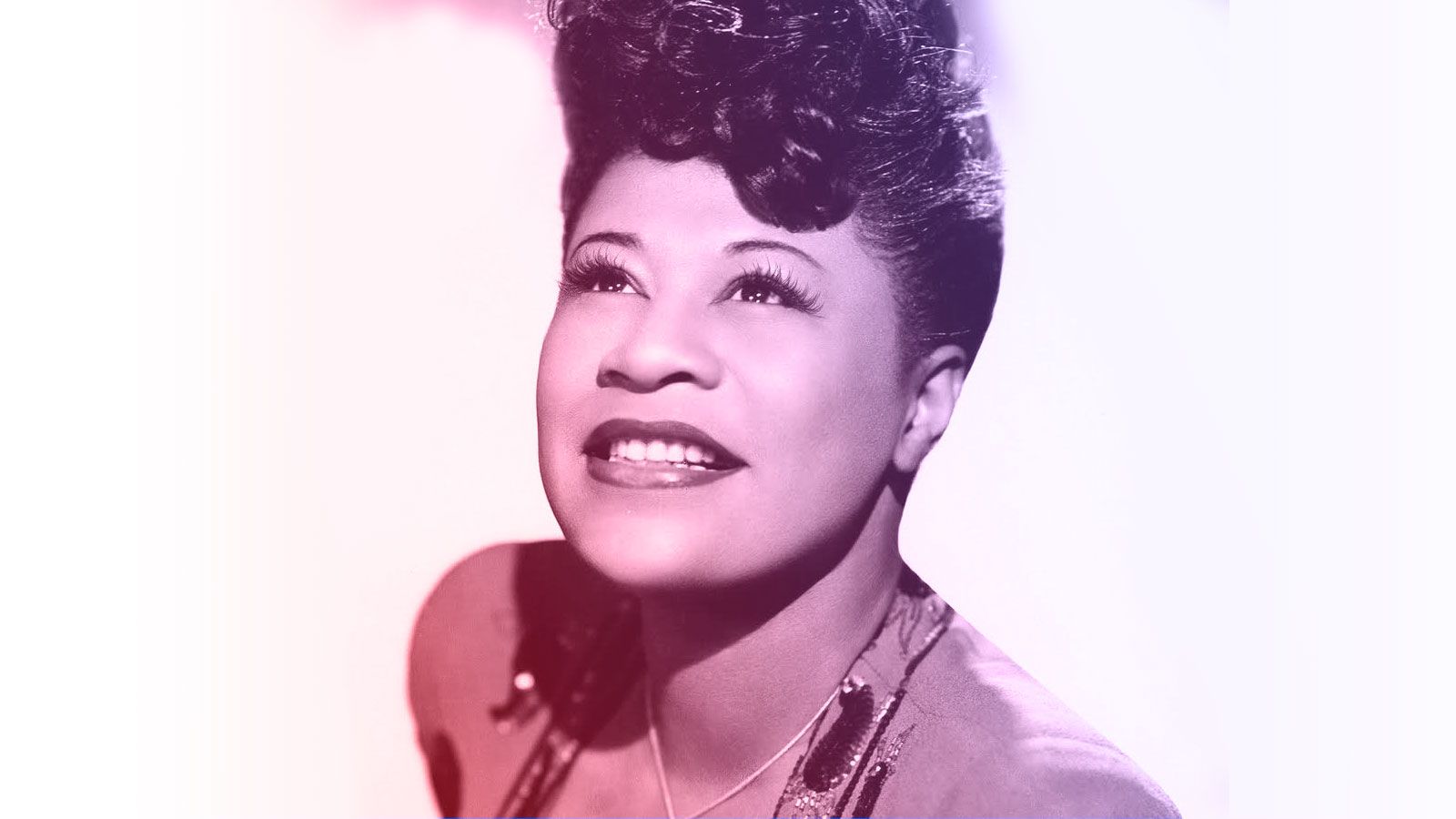
Biography
Full name: Ella Jane Fitzgerald
Date of birth: 25 April 1917
Place of birth: Newport News, Virginia, United States
Date of death: 15 June 1996
Occupation: Singer, songwriter
Musical genres: Jazz, swing, scat, blues, pop
Childhood and early musical career
Ella Fitzgerald grew up in Harlem, New York, during the Great Depression. She had a difficult childhood, losing her mother at a young age and living in children’s homes.
As a teenager, Ella dreamt of becoming a dancer, but it was through singing that she came to be noticed. In 1934, at the age of 17, she took part in a talent contest at the Apollo Theatre in Harlem, where she impressed the audience with her powerful voice and sense of rhythm. This contest marked the start of her musical career.
Musical career: A meteoric rise
After winning the competition, Ella Fitzgerald performed in Harlem’s jazz clubs, and in 1935 she joined the band of Chick Webb, a renowned jazz bandleader. It was with this band that she recorded tracks such as A-Tisket, A-Tasket, which became a hit.
In the years that followed, Ella became one of the most sought-after singers of the swing era. She performed with big bands and recorded numerous albums that established her as a key figure in jazz.
Style and vocal technique
Ella Fitzgerald is famous for her impeccable vocal technique, her wide vocal range and her ability to navigate effortlessly between different musical genres. She was also a master of scat, a form of vocal improvisation using meaningless syllables, which became one of her most recognisable trademarks.
Her ability to interpret jazz standards with raw emotion, whilst maintaining great technical precision, has made her an undisputed icon of the genre.
The 1950s–1960s: Global acclaim
In the early 1950s, Ella Fitzgerald began a series of songbook recordings dedicated to great American composers such as Cole Porter, George Gershwin, Irving Berlin and Duke Ellington. These albums, such as *The Cole Porter Songbook* (1956) and *The Gershwin Songbook* (1959), are masterpieces of American song and cemented her position as one of the greatest jazz singers of all time.
She also performed with the biggest names in jazz, including Louis Armstrong, with whom she recorded several memorable albums.
Later career and living legend
The 1970s and 1980s marked a period of maturity for Ella Fitzgerald, who continued to perform around the world. She recorded numerous live albums, capturing the essence of her masterful voice on stage.
Over the decades, she received numerous honours, including 13 Grammy Awards and a Grammy Lifetime Achievement Award in 1967.
Personal life
Although she had an exceptional career, Ella Fitzgerald’s personal life was marked by struggles, including health problems and financial difficulties in her early years. She was married twice, but her career often took precedence over her private life.
She also experienced periods of depression, but her music remained a means of expression for her, and she always showed impressive resilience in the face of life’s challenges.
Death and legacy
Ella Fitzgerald died on 15 June 1996 following complications from diabetes, aged 79. Her passing marked the end of an era, but her influence remains ever-present in the world of jazz and music in general.
Cultural and Musical Impact
Ella Fitzgerald is one of the most influential voices in the history of jazz. She paved the way for female jazz singers and inspired generations of musicians and singers. Her ability to perform songs with such mastery and emotion continues to set the standard in the world of music.
She is often cited by artists such as Billie Holiday, Sarah Vaughan and Diana Krall as a major source of inspiration.