
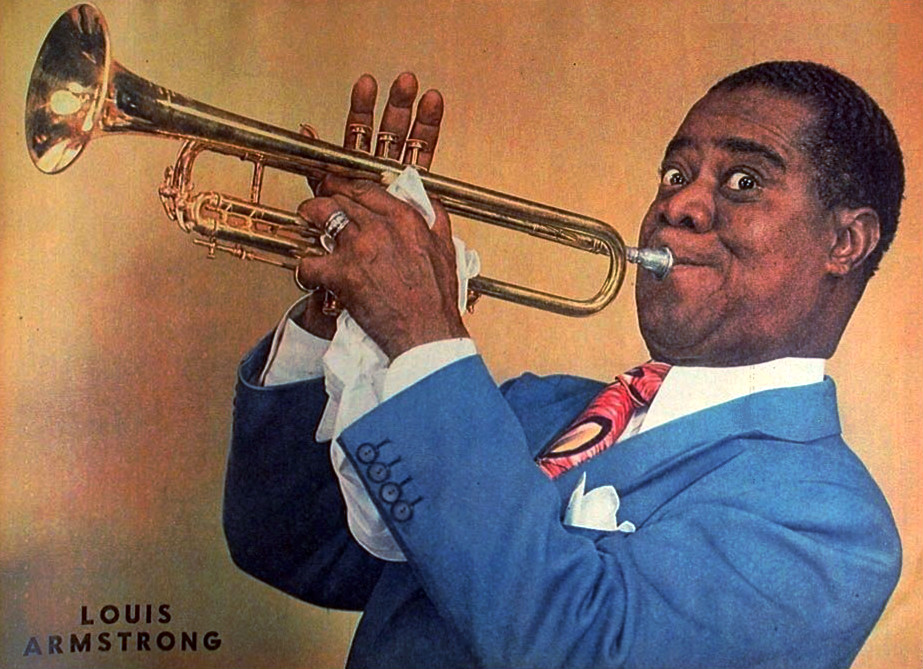
Biography
Full name: Louis Daniel Armstrong
Nicknames: “Satchmo”, “Pops”
Date of birth: 4 August 1901 (although Armstrong sometimes stated 1900)
Place of birth: New Orleans, Louisiana, United States
Date of death: 6 July 1971
Occupation: Trumpeter, singer, composer, actor
Musical genres: Jazz, swing
Childhood and early musical career
Louis Armstrong was born in a poor neighbourhood of New Orleans known as ‘The Battlefield’. His youth was marked by poverty and difficult living conditions. At the age of 11, he was sent to a boys’ home following an incident involving a firearm. It was there that he discovered music and learnt to play the cornet. On his return, he became a self-taught musician and began playing in local brass bands and cabarets. In 1918, he was recruited by the famous trumpeter King Oliver, who became his mentor and took him to Chicago in 1922, marking the start of his professional career.Musical career: A jazz pioneer
In 1925, Louis Armstrong recorded with the Hot Five and the Hot Seven; these sessions revolutionised jazz by emphasising individual improvisation. These recordings included iconic tracks such as:- West End Blues
- Heebie Jeebies (introducing scat singing to vocal jazz)
- What a Wonderful World
- Hello, Dolly!
- When the Saints Go Marching In
Style and contributions
Louis Armstrong is regarded as a pioneer of jazz:- He transformed the role of the soloist in jazz, emphasising individual virtuosity.
- His distinctive vocal style, notably his husky voice and unique phrasing, has influenced generations of artists.
- He popularised scat, a vocal technique involving improvisation using meaningless syllables.
Awards and honours
- Grammy Lifetime Achievement Award (1972, posthumously)
- Induction into the Rock and Roll Hall of Fame for his impact on popular music
- One of the first jazz musicians to achieve worldwide fame